
Quick answers on products, quotations, fabrication, quality and delivery.
Answers are based on company, product, project and quality information published on this website. Pricing, committed delivery, final manufacturability and project-specific testing are reviewed by the responsible team after RFQ intake.
S&D BUYER / ENGINEERING FAQ
If the answer is not here, continue directly with an RFQ.
Review the published FAQ, products and project references first, then use the Project RFQ for actual quotation, delivery and manufacturability review. Confidential drawings and specifications use the secure-data process.
Products & referencesStart with product scope and published project references.
Core RFQ inputsEarly review focuses on material, design pressure and temperature, nozzle and manhole requirements, surface finish and accessories.
Project-specific reviewPrice, delivery, applicable codes and inspection scope are finalized after reviewing the actual specification.
ConfidentialityCustomer drawings, cost and contract material use an NDA-controlled secure channel rather than ordinary inquiry attachments.
COMPANY
1 questionsCompany
01What does S&D KOREA do?
S&D KOREA's core business is pressure-vessel and storage-tank manufacturing, with semiconductor, high-purity chemical, bio/pharmaceutical and food & beverage applications as priority industries.View related page
PRODUCT
6 questionsProducts
01What is the fabrication scope for Semiconductor & Chemical Vessels?
Project-specific pressure vessels and storage tanks for semiconductor and chemical processes, including E.P. tanks, lined tanks and related structures for chemical storage, central chemical supply systems (CCSS), wet processes and waste-liquid service. Relevant experience and applications: MPCA AZ4 · Arizona · documented project record · 200 m³ × 6 · MPCA AZ4 · Arizona · documented project record · 92.5 m³ × 3 · Samsung Texas Taylor T-PJT · 50 units · multiple sizes; detailed breakdown under verification · Pressure-vessel, storage-tank and related structural fabrication · Chemical storage · CCSS · Wet processes · Waste-liquid storage.View related page
02What is the fabrication scope for E.P, Lining & PCW Tanks?
A core S&D KOREA business: round or rectangular tanks for semiconductor and high-purity chemical PCW, ultrapure water, lined storage and waste-liquid service, configured with project-specific nozzles, internals and finishes. Relevant experience and applications: Semiconductor E.P. tank projects · Chemical tank projects · Lined-tank projects · High-purity PCW tank projects · Waste-liquid tank projects · Ultrapure water · Process chemicals · Lined storage · Waste liquid.View related page
03What is the fabrication scope for Mixing Tanks?
Mixing systems that integrate tanks, agitators, piping, access platforms and utilities into the production layout for blending, purification and hygienic processes. Relevant experience and applications: Multi-tank mixing lines · Agitator and top-nozzle configurations · Stainless-steel piping and access platforms · Production-line integration · Mixing · Purification · Food processing · Pharmaceutical processing.View related page
04What is the fabrication scope for Semiconductor Equipment & Frames?
Precision structures for semiconductor equipment—including HP unit, sliding and chamber frames, strip tanks, bodies and frames, and Omega-S frames—fabricated to dimensional and assembly requirements. Relevant experience and applications: HP Unit Frame · HP Sliding Unit Frame · HP Chamber Unit Frame · Strip Tank / Body / Frame · Omega-S Frame · Equipment frames · Module housings · Chamber supports · Custom structures.View related page
05What is the fabrication scope for Food & Snack Machinery?
Stainless-steel structures, piping, conveyors and access platforms configured for cleaning, hygiene and maintenance requirements across food and snack production lines. Relevant experience and applications: Snack-production equipment · Integrated conveyors and piping · Stainless-steel process lines · Fabrication designed for cleaning and maintenance · Snack lines · Food processing · Conveying · Hygienic processes.View related page
06What is the fabrication scope for Ultrasonic Cleaning & Industrial Machinery?
Custom industrial systems integrating ultrasonic cleaning, tanks, piping, controls and structural components around the workpiece, required throughput, automation level and installation conditions. Relevant experience and applications: Ultrasonic cleaning equipment · Industrial piping and tank modules · Automation-ready structures · Custom machinery fabrication · Ultrasonic cleaning · Industrial washing · Custom machinery · Process modules.View related page
QUOTATION
6 questionsQuotation
01What information is useful for a pressure-vessel quotation?
For an initial pressure-vessel or storage-tank quotation, start with five inputs: material, capacity/major dimensions, design pressure/design temperature, quantity and target delivery. Final drawings are not required to start the initial engineering review.View related page
02What should I provide for a mixing-tank quotation?
A mixing-tank inquiry can start with the application, approximate capacity and quantity. If available, media characteristics, viscosity or solids, mixing objective, operating temperature, material, agitator or jacket requirements, cleaning conditions and target delivery help accelerate review. Agitator type and motor specification are determined after process-condition review.View related page
03What information is useful for a piping-project quotation?
A chemical or utility piping inquiry can start with the media, approximate nominal size and length, and installation location. If known, add material or lining, pressure and temperature, connection method, piping drawings or layout, valve and fitting scope, site installation or removal requirements and target schedule.View related page
04What are the payment and warranty terms?
Payment terms, warranty period, currency, Incoterms and other commercial terms are not published as fixed standard conditions on the website. They are confirmed at quotation or contract stage according to supply scope, destination, value, installation or commissioning and the project contract.View related page
05What do I need to request a quotation?
For pressure-vessel and storage-tank quotations, the five priority inputs are tank material, design pressure/design temperature, nozzle/manhole requirements, wetted/non-wetted surface finish, and other accessories. Final drawings are not required for an initial inquiry. Quantity, capacity, application, media, destination, target schedule, applicable code and project-specific testing requirements can be added as supporting information.View related page
06Can I inquire without final drawings?
An initial inquiry and feasibility review can begin without final drawings. Share whatever is known about the application, approximate capacity or size, media, preferred material and quantity. Final dimensions, nozzles, wall thickness and detailed specifications are confirmed through engineering and drawing review.View related page
ENGINEERING
8 questionsEngineering
01What is the difference between an E.P Tank and a Lining Tank?
An E.P Tank is centered on controlled stainless wetted surfaces such as electropolishing, while a Lining Tank uses a project-specified internal lining layer to separate the base material from the process media. Selection depends on media corrosivity and purity requirements, temperature and pressure, cleaning conditions and the client specification.View related page
02How do I choose between a dimple and spiral jacket?
Dimple or spiral jacket configurations can be reviewed for food and mixing-tank projects. Selection depends on the required heating or cooling function, utility, temperature and pressure, vessel geometry, cleaning and maintenance needs and fabrication conditions. Final heat-transfer performance and jacket design are confirmed through project-specific engineering review.View related page
03Can S&D KOREA review heat-exchanger fabrication?
S&D KOREA's established business scope includes heat-exchanger fabrication for semiconductor and chemical applications. For a new project, fabrication scope should be reviewed after confirming the heat-transfer duty, media, required thermal duty or operating conditions, material, pressure and temperature, connections and applicable code.View related page
04What semiconductor chemical vessels can S&D KOREA fabricate?
S&D KOREA's core scope is pressure vessels and storage tanks. Semiconductor and high-purity chemical projects may also include E.P. tanks, lined tanks, PCW process tanks and related structures where supported by the project requirements. Final material, pressure/temperature, surface finish, inspection and certification applicability are determined per customer specification.View related page
05Can you fabricate food-process or jacketed tanks?
Food storage and mixing tanks are reviewed around stainless construction, hygiene, cleanability, maintenance and heat-transfer requirements. Dimple or spiral jackets can be considered by project, together with agitators, piping, platforms and production-line integration.View related page
06Can you handle chemical piping components and turnkey work?
S&D KOREA can review chemical piping components such as PTFE-lined fittings. Depending on the project, turnkey coordination may include tank installation, piping, electrical and construction interfaces. The actual supply boundary and responsibility are defined from the site conditions and purchasing specification.View related page
07What is the AIR & AQUA modular piping system?
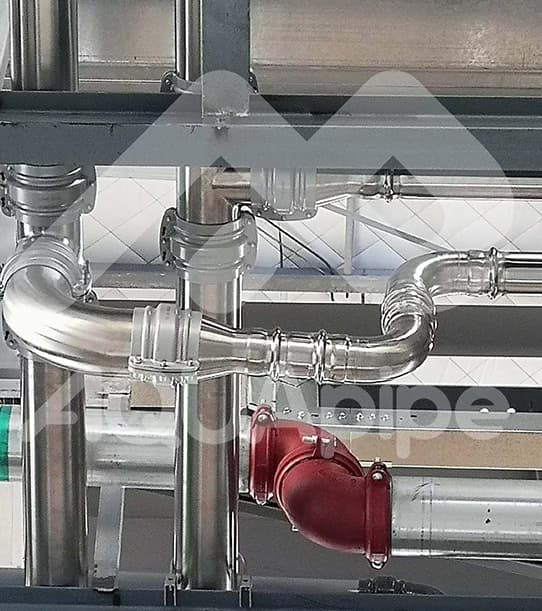
Modular piping systems can be reviewed for factory compressed air and water utilities. Aluminum and stainless materials with assembly-oriented connections can reduce field welding and improve installation speed and maintainability. Pressure rating, connection method, leak testing and site applicability are confirmed per project.View related page
08Should I use SUS304 or SUS316L?
Stainless grades such as SUS304 and SUS316L are common fabrication materials, but selection must consider media corrosivity, temperature and pressure, cleaning conditions, finish or lining requirements and client specifications. Final material selection and suitability are confirmed through project-specific engineering review.View related page
PROJECT
1 questionsProject References
01What project track record does S&D KOREA have?
The current annual project data lists 55 project records and 598 fabricated units. The track record is centered on semiconductor/display, high-purity chemical, vessel and related equipment projects, including a 200 m³-class large-vessel reference. Listed capacities are nominal project references, not complete design specifications.View related page
QUALITY
3 questionsQuality
01Does S&D KOREA currently hold ASME U authorization?
S&D KOREA holds a valid ASME Certificate of Authorization (U): certificate number 60946, valid July 14, 2026 through July 14, 2029, covering the manufacture of pressure vessels at the listed location and controlled field sites. PE STAMP [TEXAS] notations in historical project records remain facts of those projects and are presented separately.View related page
02Can Korean regulatory and inspection requirements be reviewed?
Regulatory authority, applicable code and inspection scope for new equipment cannot be determined from the product name alone. Pressure-vessel classification, media, design pressure and temperature, installation location and client specification must be reviewed to determine the Korean regulatory, inspection and certification requirements. Any requirements associated with Korean safety or energy authorities must be confirmed per project.View related page
03What inspection and quality documents can be provided?
Inspection and submittals are configured to project requirements. Engineering review can address material records, fabrication and welding control, dimensional and visual inspection, pressure or leak testing, NDE, FAT, third-party inspection and document deliverables. Exact methods and document lists follow the purchasing specification and applicable code.View related page
DELIVERY
3 questionsDelivery
01How are after-sales support and warranty handled?
After-sales and warranty scope is not published as one fixed condition for every project. Responsibility and support terms are defined during quotation and contract review according to equipment type, supply, installation or commissioning scope, site location and contract conditions.View related page
02How long does delivery usually take?
Rather than quoting one standard lead time, the schedule should be reviewed against equipment type, quantity, size, material and bought-out items, drawing approval, inspection or certification requirements and delivery site. Share the target date first and the team can respond after engineering and production review.View related page
03Can S&D KOREA handle installation or turnkey scope?
Depending on the project, scope may range from fabrication and delivery only to installation and coordination with piping, electrical and construction interfaces. Site access, work area, utility tie-ins, commissioning requirements and responsibility boundaries must be reviewed before confirming scope.View related page
SECURITY
1 questionsNDA & Security
01How should I send confidential drawings?
Do not attach confidential drawings, cost data, client-confidential information or trade secrets to the general inquiry form. Share the project overview first, request an NDA and secure transfer channel, then provide confidential material through the agreed route.View related page
FAQ + ENGINEER REVIEW
For a real project, move directly to the RFQ.
You can submit the conditions already known even before final drawings are complete.